
Published by Evolution Capital | IT/Telco M&A Specialists | 25 Years | 250+ Transactions
Evolution Capital · 25 Years · 250+ Deals
First Data Jitters
The quality of your data can have a greater impact on your valuation than many founders realise. This guide explains why buyers place so much emphasis on financial accuracy, consistency, and transparency and how better data creates stronger deals.
Published by Evolution Capital | IT/Telco M&A Specialists | 25 Years | 250+ Transactions
25+
Years in technology M&A
250+
Transactions
$1bn+
In completed transactions
Buyers don’t buy EBITDA—they buy confidence that the EBITDA is accurate, verifiable, and sustainable. Clean, consistent data is the foundation of every successful transaction.
Evolution Capital · From the trenches
- At a Glance
What You'll Learn.
Discover why data quality is one of the biggest drivers of buyer confidence, how Financial Due Diligence teams assess your numbers, and the practical steps that help businesses achieve faster transactions, stronger valuations, and fewer surprises during a sale.
Confidence Creates Value
A business with average financial performance and excellent data often attracts stronger offers than a business with better performance but unreliable numbers. Buyers reward certainty.
01
Why Data Quality Matters
02
The Buyer Confidence Chain
03
Data Quality vs Data Organisation
04
Common Data Problems
05
The Cost of Poor Data
06
What Good Data Looks Like
07
Quality of Cash vs Quality of Earnings
08
The Most Common FDD Findings
09
Building Better Data Before Sale
10
How Evolution Capital Can Help
New To The Biz
Cast your mind back to your first date with someone you were genuinely interested in. The nerves. The questions about what to wear, what to say, how much to reveal, how to come across as interesting without trying too hard. You wanted them to like you, to trust you, to see the best version of what you had to offer.
Nobody is born with perfect game. The first time is a real learning experience. Sometimes it goes well, the chemistry is there from the start, the conversation flows, you both leave feeling like something real might be developing. Sometimes it’s a car crash. Wrong venue, wrong stories, too much too soon, and both of you counting down to the moment you can politely leave.
Selling a business for the first time works exactly the same way.
The seller sits across the table from a buyer or, in a competitive process, from several buyers at once. They want to be believed. They want to engender confidence. They want to tell a story that lands well without giving away everything upfront. And just like a first date, success depends as much on who is sitting on the other side and whether the two parties genuinely mesh as it does on what you actually have to offer.
One of the most important things a first-time seller can have alongside them is someone who has been in this room hundreds of times before. An adviser who knows what buyers want to see, what triggers anxiety, what builds confidence, and how to present the business in a way that creates genuine trust rather than awkward silence.
That trust, in an M&A process, starts with data. Clean, consistent, well-evidenced numbers that give buyers the confidence to commit.
But data alone is not quite enough. A founder who walks into that room knowing their numbers, who can answer questions without hesitation, who understands what buyers are going to look at and has thought through the answers in advance, presents a fundamentally different picture to one who is visibly uncertain about their own financials. The data provides the evidence. The seller’s ability to present it with genuine authority is what makes that evidence land. This article is primarily about the data, because that is where the work happens and where the value is built. But keep the human side in mind throughout.
Why Your Data Can Make or Break Your Deal
Is Your Business Data Ready for Due Diligence?
Discover how stronger financial reporting and buyer-ready data can reduce risk, accelerate due diligence, and maximise the value of your business.
The Emotional Reality
The Chain That Determines What You Receive
There is a simple chain that governs how much a buyer will pay and on what terms.
Data becomes evidence. Evidence creates buyer comfort. Buyer comfort determines price and terms.
Every link in that chain matters. Great revenue growth means nothing if buyers cannot verify it. A strong customer base means nothing if the numbers supporting it cannot be reconciled. An impressive EBITDA margin means nothing if buyers cannot trace it back to source documents and understand how it was calculated.
We have seen countless deals with experienced buyers, not first-timers, not nervous newcomers, but sophisticated PE funds and experienced trade acquirers, postponed and abandoned because the data simply wasn’t adequate. Not because the business wasn’t good. Because the business couldn’t prove it was good.
The credibility of the numbers you present, and the credibility of the people presenting them, is what turns a promising opportunity into a completed transaction at the price you deserve.
- Process Section
The Buyer Confidence Journey
01
Collect
Ensure financial and operational data is complete, accurate, and consistently maintained.
02
Validate
Enable buyers to reconcile every figure back to supporting evidence.
03
Build Trust
Reliable information reduces uncertainty and strengthens buyer confidence.
04
Maximise Value
Greater confidence leads to smoother transactions, stronger offers, and improved deal certainty.
Why IT Services Businesses Have No Excuse for Poor Data
Before getting into what good looks like, it is worth making a point that often gets missed: IT services, managed services, telecommunications, and cybersecurity businesses are among the most naturally data-rich industries in the UK economy.
Think about what these businesses do every day. They serve B2B customers under contracts, generating predictable, recurring transactions month after month. Every invoice, every customer, every service line, every margin is traceable. Costs map clearly to services and customers in a way that a restaurant, a retailer, or a construction company can only dream of. Monthly recurring revenue by customer. Gross margin by product. Staff utilisation by billable hour. The data infrastructure to answer every question a buyer will ask exists, or should exist, as a natural by-product of running the business.
This is what makes poor data quality in an IT services deal particularly frustrating to encounter. The raw material is all there. What is usually missing is the discipline to organise it consistently, maintain it over time, and present it in a way that tells a coherent story. That is a process and leadership problem, not a structural one. And it is entirely solvable with the right focus and the right support.
“Data becomes evidence. Evidence creates buyer comfort. Buyer comfort determines price and terms.”
Evolution Capital
Data Quality vs Data Organisation
Many founders confuse data quality with data organisation, and the difference matters more than most realise.
A well-organised data room with clearly labelled folders and searchable documents is genuinely valuable. It makes diligence efficient and signals that the business is professionally run. But it is cosmetic. It doesn’t answer the fundamental question every buyer is really asking: can I trust these numbers?
Data quality is about accuracy: do the numbers reconcile across different sources? It is about completeness: is all relevant information captured and available? It is about consistency: have accounting policies and reporting formats remained stable over time so that trends can be read reliably? And it is about auditability: can any number be traced back to its source documents?
A data room can be beautifully organised and still contain unreliable, inconsistent data that no serious buyer will underwrite. The founders who understand this distinction, and address it well before going to market, are the ones who move through diligence quickly and command the multiples their businesses deserve.
What Happens When the Data Doesn't Add Up
The buyer’s FDD team had been working through the data room for three days when they asked for a meeting.
The seller expected questions about EBITDA adjustments or customer contracts. What the FDD lead actually opened with was: “We need to talk about your data quality. We’re struggling to reconcile basic numbers across different sources, and that’s making it impossible to validate anything else.”
Management accounts showed £8.2 million revenue for the trailing twelve months. The filed accounts showed £8.6 million. The customer list provided in the data room totalled £7.9 million. Which number was right?
EBITDA was reported as £1.4 million. But the FDD team couldn’t tie it back to the P&L because the management accounts format had changed twice during the year, making any trend analysis impossible.
Customer churn was claimed at “around 10%“. There was no system tracking which customers had left, when, or why. No cohort analysis. No historical retention data. Just an estimate.
The aged debtor schedule showed £420,000 in receivables over 90 days. When asked for details on collectability, the response was: “I’d need to go through customer by customer. We don’t have that documented.”
After two weeks of trying to build confidence in the numbers, the buyer walked away. Not because the business wasn’t good. Because they couldn’t trust the data enough to understand what they were actually buying.
What Poor Data Quality Actually Costs
Valuation compresses
If buyers cannot verify EBITDA or revenue with confidence, they build risk premiums into pricing. A £1.5 million EBITDA might be worth 8x if the data is robust. If data quality is poor, buyers assume problems lurk beneath the surface and price accordingly, perhaps 6 to 6.5x instead. On £1.5 million EBITDA, that 1.5 to 2x multiple compression represents £2.25 to £3 million in lost enterprise value.
The timeline extends
Poor data quality extends diligence timelines significantly. Instead of six to eight weeks, you are looking at twelve to sixteen as the FDD team requests information multiple times, attempts reconciliations, and circles back with clarifying questions. Extended timelines increase deal failure risk. Market conditions change. Buyers develop cold feet. The longer a process runs, the more that can go wrong.
Professional fees escalate, sometimes at the seller's expense
When FDD teams must spend additional weeks reconciling data and rebuilding reports, their fees increase. What many sellers don’t realise is that buyers can and do ask sellers to contribute to FDD costs when information is so poor that the buyer’s advisers have had to do work that should never have been necessary. A transaction where data quality problems extended diligence by four weeks generated an additional £35,000 in FDD fees that the seller ultimately bore. It is not common, but when data is genuinely inadequate, it happens.
Larger escrow provisions and broader warranties
If buyers cannot verify certain numbers, they protect themselves with larger escrow holdbacks. Instead of 5 to 10% of purchase price in escrow, you might face 15 to 20%. They will also seek broader warranty and indemnity protections in the SPA, representing ongoing financial exposure for the seller well beyond the completion date.
The deal collapses entirely
In serious cases, buyers walk away. If they cannot get comfortable with the numbers after reasonable effort, they will not proceed. Every deal that collapses due to data quality represents three to six months of wasted time, significant sunk costs in advisory fees, and the challenge of re-engaging the market after a failed process.
The Gold Standard: What Good Data Actually Looks Like
The businesses that move through diligence quickly and with confidence are not necessarily the most profitable or the fastest growing. They are the ones where the data is comprehensive, consistent, and immediately verifiable. This is what that looks like in practice.
Customer information
A buyer-ready customer database goes far beyond names and contract values. It should include contract terms, pricing, service scope, billing details, historical revenue, renewal dates, and notice periods. Buyers also expect cohort analysis, churn tracking, and customer satisfaction data where available. Together, this transforms revenue from a headline figure into clear evidence of customer relationships, retention, and sustainable growth.
Product and service information
Gross margin by service line, clearly tracked and consistently calculated over multiple years. Revenue and margin by product category: managed services, professional services, connectivity, hardware, licensing. Where the business makes its money, and the trend in that mix over time.
Staff information
Buyers expect complete employee records, including roles, salaries, contracts, bonus structures, turnover history, and contractor compliance. With people costs typically accounting for 40–60% of total costs in IT services businesses, incomplete employee data quickly undermines buyer confidence.
Financial information: the accrual accounting question
Management accounts prepared on an accrual basis, consistently applied, with revenue recognised as services are delivered rather than when cash is received. This is important specifically in IT services where annual contracts paid upfront are common.
A business invoicing £120,000 upfront for a twelve-month managed services contract should recognise £10,000 per month, not £120,000 in month one. Under cash accounting, that single invoice looks like a revenue spike. Under accrual accounting, the picture is clean and predictable. Buyers always restate to accrual if they find cash accounting, which means they rebuild the financials themselves. If there are timing distortions, they find them, and they are rarely generous in how they interpret what they find.
Detailed monthly balance sheets going back at least three years. Working capital tracked month by month. Aged debtors and creditors reconciled to the balance sheet every month. Every balance sheet item traceable to its source document.
- Expert Tip
Build Buyer Confidence Before You Go to Market
Our team helps IT and telecom businesses create the financial infrastructure, reporting, and data quality buyers expect so you enter negotiations with confidence.
Accounting processes and documentation
Written accounting policies specifying revenue recognition approach, cost allocation methodology, EBITDA calculation, add-backs, and working capital definitions. Applied consistently. If policies have changed, a clear bridge showing how prior periods would look under current policies.
The audit trail matters as much as the numbers themselves. When buyers question a figure, the response needs to be: here is the source document, here is how the number was calculated, here is the reconciliation to the P&L. Businesses where the answer is “that’s what the accountant gave us” lose credibility immediately.
How We Help
One of the more telling data quality tests that FDD teams run is comparing reported EBITDA to actual cash generation. These two numbers should tell a broadly consistent story. When they don’t, it reveals something important about either the business model or how the numbers are being presented.
A business can report strong EBITDA while generating weak cash for several reasons. Customers might be slow to pay, building up debtors while revenue is recognised. Annual contracts might be billed in arrears, meaning cash always lags income. The business might be growing fast, consuming working capital to fund that growth. Or deferred revenue might not be correctly recognised, inflating the P&L while the corresponding cash obligation sits unacknowledged on the balance sheet.
Conversely, a business can generate cash well ahead of reported EBITDA if customers pay upfront on annual contracts, if debtors are collected efficiently, or if supplier payment terms are favourable.
Neither situation is inherently problematic. But the gap between EBITDA and cash generation needs to be understood and explainable. When FDD teams build a cash flow reconciliation and find that a business has generated £1.8 million EBITDA over three years but only £600,000 in operating cash flow, they will want to know exactly why. If the answer is “strong upfront billing means cash is collected before revenue is recognised,” that is reassuring. If the answer involves persistent debtor build-up, stretching creditors, or deferred revenue liabilities that have been missed, it is a material data quality concern.
This is why having three to five years of cash flow data available, reconciled to the P&L and the balance sheet, is part of what a well-prepared data room looks like. It demonstrates that the business understands its own cash dynamics, not just its earnings. And it removes a line of FDD inquiry that can otherwise take significant time and generate significant anxiety on both sides of the table.
Quality of Cash vs Quality of Earnings: A Gap Most Founders Don't See
The Problems FDD Teams Find Most Often
Reconciliation failures
Does revenue in management accounts equal revenue in filed accounts? Does it reconcile to the customer list and to bank statements? Can EBITDA be tied back to the P&L? Do debtors in the aged schedule equal debtors on the balance sheet?
We worked on a transaction where management accounts showed £1.65 million EBITDA. Filed accounts showed £1.42 million. The seller couldn’t explain the £230,000 difference beyond “different accounting policies.” The buyer’s assumption was that the lower number was reality. They valued the business on £1.42 million. At 8x, the cost to the seller was approximately £1.8 million in enterprise value.
Inconsistent reporting formats and accounting policies
A telecommunications business we reviewed had changed their management accounts format three times in four years. Revenue categories were renamed. Costs were reclassified. EBITDA add-backs evolved. The FDD team spent £25,000 and three weeks rebuilding four years of financials into a consistent structure before they could begin any quality of earnings analysis. The seller bore the cost and the deal extended by nearly a month.
Missing or incomplete customer data
What actually exists in most founder-led businesses: an incomplete customer list with rough revenue estimates, no systematic churn tracking, customer revenue only available for the current year, missing or poorly organised contract files, and service scope that lives in people’s heads rather than in documents.
This gap makes revenue quality analysis nearly impossible and forces buyers to make conservative assumptions about everything they cannot verify.
Deferred revenue that doesn’t add up
A managed services business had £340,000 in deferred revenue on the balance sheet. When the FDD team tried to verify this by analysing customer prepayments, they could only substantiate £210,000. The buyer assumed the £130,000 difference was an accounting error and adjusted working capital accordingly. The seller received £130,000 less at completion.
Staff data that doesn’t reconcile
An MSP we reviewed claimed 42 employees. The employee list showed 38 people. Three additional people were contractors who should have been employees under IR35 rules. One person listed had left six months earlier but remained on the payroll system. Reconstructing accurate employee costs revealed staff costs were 8% higher than reported. This flowed through to reduced EBITDA and a lower valuation.
Data quality is not just about what is in the data room. It is also about who presents it and how they respond to questions under pressure.
There is a significant difference between a seller who can say “our gross margin was slightly lower in Q3 because we had two large professional services engagements where we brought in specialist contractors, and you can see that in the cost of sales line, here” and one who says “I’m not sure, I’ll need to check with my accountant.” The first response builds confidence. The second erodes it. Buyers notice, and it colours how they interpret everything else.
Seller confidence in an M&A process is not about bravado. It is about being genuinely familiar with your own financials: understanding what drives your margins, knowing where the add-backs sit and why each one is legitimate, being able to explain movements in working capital month by month, and walking a buyer through the normalised EBITDA calculation without having to look it up. A seller who presents their numbers with quiet authority, who welcomes scrutiny rather than deflecting it, who has clearly lived inside these numbers rather than just produced them for the occasion, is a seller buyers trust.
This level of familiarity does not arrive automatically. It is the product of working closely with financially qualified advisers over an extended period before the sale process begins. Understanding what EBITDA actually means and what it doesn’t. Knowing the difference between gross margin and contribution margin, and why both matter. Understanding how a buyer will look at your working capital, and what the normalised position actually is. These are not things most founders learn in the course of running their business. They are things you learn when you specifically prepare for the moment you will have to explain your business to people who do this every day.
The Seller Who Can Speak to the Numbers
The time to address data quality is 18 to 24 months before you plan to sell. By the time you are in active discussions with buyers, it is too late to fix the structural issues.
The reason this timeline matters is not just that problems take time to fix. It is that buyers look at trends, typically over three to five years, and a single year of clean data is not a story. Two or three years of clean, consistent, improving data is. The 18 to 24 months before going to market is the window in which you build the numbers that will be scrutinised, the period that forms the foundation of the quality of earnings analysis. Going to market with eighteen months of genuinely clean, well-managed financials is a very different proposition to going to market with three months of cleanup visible in the most recent period and a messier story behind it.
Implement proper management information systems. Move from spreadsheets to integrated financial systems that capture transactions at source, provide audit trails, generate consistent reports, and enable drill-down from summary to transaction level. Cloud-based accounting systems like Xero or QuickBooks, integrated with CRM and project management tools, are adequate for most businesses up to £15 to £20 million revenue. The investment is modest relative to the value it creates.
Establish consistent accounting policies and document them. Write down your revenue recognition approach, cost allocation methodology, EBITDA calculation, and working capital definitions. Apply them consistently. If you change them, document the change and provide a bridge to prior periods.
Build systematic customer and employee data tracking. Create a customer database with contract details, pricing history, and retention tracking, updated monthly as a matter of routine rather than assembled from scratch when diligence begins. Do the same for employee data.
Conduct monthly reconciliations. Management accounts to filed accounts, revenue to customer records to bank receipts, balance sheet items to supporting schedules. Identify and resolve discrepancies immediately.
Consider having your accounts audited. Most smaller IT services businesses are not legally required to have audited accounts, and many don’t. But an audit provides an external anchor of credibility that no amount of internal reconciliation can replicate. When a buyer sees three years of independently audited accounts, the reconciliation question largely answers itself: a qualified auditor has already tested that the numbers are consistent and supportable. It is worth understanding that the audit process itself often surfaces adjustments, items the auditor requires to be treated differently from how they were recorded. Understanding what those adjustments are and why they were made is important, because buyers will ask. The audit should not be a black box: the founder needs to understand what the auditor found and why, not just rely on the signed opinion.
Commission vendor due diligence. It is worth being honest here: VDD is not the right call for every transaction. It is most commonly recommended on larger deals, and almost exclusively on competitive processes where having a credible independent report on the data room gives multiple buyers a common evidential foundation. For smaller transactions or bilateral processes, it may not be proportionate. But where it is appropriate, it is the gold standard for assurance: it surfaces issues while you have time to address them, sets a normalised EBITDA baseline that buyers reference, demonstrates transparency, and reduces diligence timelines significantly. The cost of the report can prevent multiples of that in price erosion.
Building Data Quality Before You Need It
The data quality issues described in this article develop gradually over years of running a business, and they are rarely visible to the people inside it. Founders don’t know the numbers don’t reconcile because no one has ever tried to reconcile them. They don’t know customer data is incomplete because it has always been complete enough for operational purposes.
The problem surfaces when a buyer’s FDD team, with no prior knowledge of the business and no emotional investment in making the numbers work, sits down and starts testing everything from scratch.
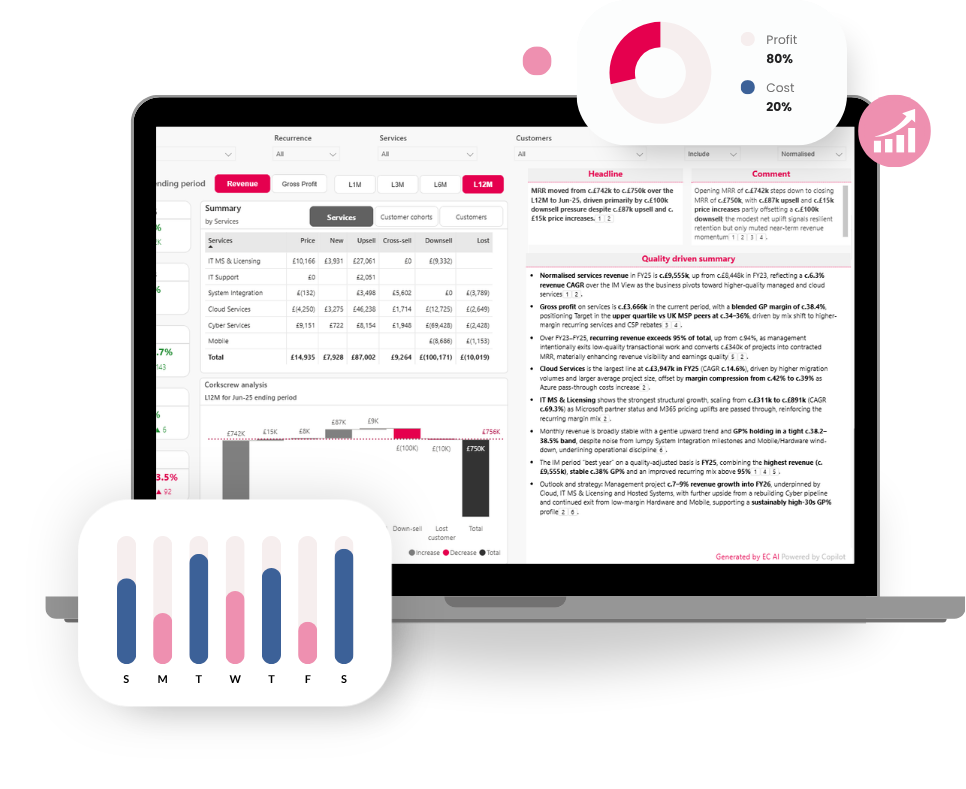
EC Analytics (Virtual CFO / CFO Assist) works with IT services businesses in the period before sale to build the financial infrastructure that buyers expect to find: reliable, consistent, auditable data; gross margin tracking by product, customer, and supplier; customer and employee data repositories maintained as a matter of routine; and management information that tells the story of the business clearly. Clients also get direct time with experienced, qualified advisers who understand the financial mechanics of an M&A process and the specific dynamics of IT and Telco businesses, so founders don’t just have the numbers, they understand them and can speak to them with authority.
One client engaged EC Analytics eighteen months before going to market. When they went to market, diligence took six weeks rather than the typical ten to twelve. No material data quality issues were raised. The business commanded 8.5x in a market where 7 to 7.5x was more typical. Getting the data right created approximately £1.5 to £2 million in incremental enterprise value.
Corporate Finance. When you are ready to go to market, the quality of your data is the foundation we build the sales process on. Good numbers, well organised and consistently presented, give us the ability to tell a compelling story to buyers: not just what the business is worth, but why the numbers support that value and why buyers can rely on them. Through our platform, we can give buyers in a competitive process structured access to selected analyses at appropriate stages, customer revenue schedules, gross margin by service line, staff cost analysis, working capital trends, in a format that experienced buyers recognise and trust. Rather than buyers requesting information and sellers scrambling to produce it, the story is ready, structured, and presented proactively. The quality of the underlying data determines how well we can do this job. Which is exactly why EC Analytics and Corporate Finance work together rather than in sequence.
On the FDD side, when we review an IT services business for a buyer, data quality is always the first test. Before we can assess the quality of earnings, the sustainability of margins, or the reliability of the revenue base, we need to know whether we can trust the numbers at all. The businesses that pass that test quickly move through diligence faster, with fewer adjustments, and with buyers who are more confident, which in this context means more willing to pay.
How Evolution Capital Can Help
A Note on Confidentiality
- Our Blog
Related Articles
Why does data quality affect the valuation of an IT services business?
Because buyers are making a multi-million pound decision based on information you provide. If they cannot verify that the numbers are accurate and consistent, they build risk premiums into pricing to account for what might be lurking beneath the surface. A business with clean, auditable data and a business with poor data quality can report identical EBITDA and receive valuations that differ by 1.5 to 2x, representing millions in enterprise value on a typical mid-market transaction.
What is the most common data quality problem in IT services M&A?
Reconciliation failures: the basic test of whether revenue, EBITDA, and balance sheet figures tie together across management accounts, filed accounts, customer records, and bank statements. When they don’t, and the seller cannot explain the differences, buyers lose confidence in everything else the data room contains.
What does gold standard data look like for an IT services business preparing for sale?
At minimum: three to five years of management accounts prepared on an accrual basis in a consistent format; detailed customer records including contracts, pricing history, and retention data by cohort; gross margin tracked by product, by customer, and by service line; a complete and reconciled employee register with salary, tenure, and contract data; monthly balance sheets reconciled to supporting schedules; and working capital tracked and documented month by month. The standard is not perfection. It is completeness, consistency, and the ability to trace every number back to a source document.
When should I start using accrual accounting if my IT services business currently uses cash accounting?
As soon as possible, and certainly at least eighteen months before going to market. FDD teams always restate to accrual accounting when reviewing IT services businesses with annual upfront contracts, because cash accounting distorts the timing of revenue and makes trends unreliable. If you are already on accrual accounting with consistent policies applied over multiple years, this is a material advantage. If you aren’t, the restatement will happen either way, and it is better to control it than to have a buyer’s FDD team do it under time pressure.
Can a seller be asked to pay for the buyer's FDD costs?
It is not standard, but it can happen when data quality is so poor that the buyer’s FDD team has had to do work that should have been the seller’s responsibility. We have seen cases where sellers have contributed to extended FDD fees when diligence timelines significantly exceeded what was anticipated due to data problems. It is one of the less visible but very real costs of going to market underprepared.
What is vendor due diligence and when is it worth commissioning?
Vendor DD is an independent FDD review of your own business, commissioned by the seller before going to market. It is not appropriate for every transaction: it tends to be recommended on larger deals and is most valuable in competitive processes where multiple buyers can rely on a common independent report rather than each conducting their own separate diligence. For the right transaction, it is the gold standard for giving buyers confidence in the data, setting a defended normalised EBITDA baseline, and reducing diligence timelines significantly. The cost typically runs £20,000 to £50,000 and can prevent multiples of that in price erosion.
- FAQ
Frequently Asked Questions
- Request a Confidential Consultation
Discover Your Business Value
Start with a strategic assessment to understand your maximum potential valuation in the current market.

Company
About Us
Blogs
Our Location
Careers
Our Services
About Us
Sell Side
Buy Side
Data Work
Resources
Faq
Client Dashboard
Support
Our Location
Contact Us
- (020) 3696 2810
- Info@evolutioncapital.com
- 68 King William Street, London, EC4N 7HR
- The Granary, Oak Lane, Chichester, PO20 7FD