
Published by Evolution Capital | IT/Telco M&A Specialists | 25 Years | 250+ Transactions
Evolution Capital · 25 Years · 250+ Deals
Recurring Recurring Recurring
Not all recurring revenue is created equal. Learn why buyers look beyond ARR and how factors like contract quality, pricing power, customer retention, and revenue mix can significantly impact the valuation of an IT services business.
Published by Evolution Capital | IT/Telco M&A Specialists | 25 Years | 250+ Transactions
25+
Years in technology M&A
250+
Transactions
$1bn+
In completed transactions
Revenue quality not revenue volume is one of the biggest drivers of valuation in IT services M&A. Buyers assess contract strength, customer concentration, pricing power, churn, and revenue predictability to determine how sustainable future earnings really are.
Evolution Capital · From the trenches
- At a Glance
What You'll Learn.
This article explains how experienced buyers assess revenue quality beyond headline ARR, revealing the factors that drive higher valuations in IT services M&A. You’ll gain insight into the commercial and financial metrics that matter most during due diligence and discover practical ways to build a more resilient, valuable business before going to market.
Revenue Doesn’t Equal Value
Two businesses with identical recurring revenue can receive dramatically different valuations. The difference lies in the quality, predictability, and resilience of that revenue not simply its size.
01
New To The Biz
When Tony Blair came to power in 1997, his platform was distilled into three words that became instantly memorable: “Education, Education, Education.” Brilliant messaging. Three words that positioned education as the cornerstone of national success, the priority above all others, the foundation upon which everything else would be built.
In IT services M&A, recurring revenue has become our equivalent rallying cry. Buyers chase it. Sellers optimise for it. Corporate finance advisers market it. Everyone agrees that recurring revenue is what separates valuable businesses from transactional ones, the difference between commanding an 8 to 10x EBITDA multiple and struggling to achieve 6x.
And they are broadly right. But like most political slogans, the headline masks the complexity. Recurring revenue is critical, but the simple number masks the questions that actually determine value. What kind of recurring revenue? How sticky is it? What about professional services that are not strictly recurring but not one-off either? And where do hardware sales and refresh cycles fit in?
A private equity fund walked away from a £12 million MSP acquisition despite impressive headline numbers. The seller had £2.8 million in annual recurring revenue, strong profitability, solid customer relationships. On paper: ideal. Then the diligence team looked beyond the number. They found that £900,000 of that ARR was scheduled to renew within 90 days of completion, another £600,000 sat with customers on month-to-month terms who could cancel with 30 days notice, and the top three customers represented 41% of total revenue with all three contracts due for renewal within twelve months.
Same revenue. Same EBITDA. Completely different risk profile. The deal collapsed in week four.
After 250 transactions in this sector, we have learned that recurring revenue is the starting point of the conversation, not the conclusion.
Why Revenue Quality Trumps Revenue Quantity in IT Services M&A
Preparing for an Exit?
Our specialists help IT and telecom founders strengthen financial infrastructure, improve revenue quality, and maximise valuation before sale.
The Emotional Reality
Why Buyers Pay Premiums for Recurring Revenue
Before getting into the complexity, it helps to understand why recurring revenue commands such a premium in IT services M&A.
The cash flow is predictable. Buyers can model forward confidently. Debt providers can lend against it. Acquisition targets can be valued with far less uncertainty than transactional businesses where performance depends entirely on next quarter’s sales pipeline.
Progress is measurable month by month. ARR growth, churn rates, customer retention: these metrics tell you immediately whether a business is healthy or deteriorating. Project-based businesses bounce around based on the timing of large contracts. Managed services businesses reveal their true trajectory continuously.
The economics are compelling. Win a customer once, generate revenue for years. Customer acquisition costs amortise over multi-year relationships while the cost to serve typically declines as you learn the customer’s environment.
So yes, recurring revenue is fundamental. But the headline number tells you almost nothing about quality, sustainability, or value. Two businesses with identical ARR can command valuations differing by 40 to 50% based on what sits underneath.
- Process Section
How Buyers Evaluate Revenue Quality
01
Validate the contracts
Review renewal terms, notice periods, and revenue visibility.
02
Analyse customer behaviour
Measure churn, concentration, retention, and pricing history.
03
Assess long-term sustainability
Determine whether the revenue base can support future growth with minimal risk.
The ARR Illusion: Why the Number Is Only the Starting Point
Most IT services founders focus obsessively on growing their ARR figure. Hit £3 million and you’re a serious business. Reach £5 million and you’re acquisition-ready.
Except buyers don’t just care about the number. They care about what it represents, how it’s calculated, and whether it’s real or accounting artifice.
Evolution Capital
Cash vs Accrual Accounting
One distinction that catches many owner-managed businesses is the difference between cash and accrual accounting. Smaller businesses often run on cash accounting because it’s simpler. You invoice a customer £10,000 for annual managed services paid upfront, you recognise £10,000 revenue. Cash in, done.
But buyers need accrual accounting. That same £10,000 annual contract paid upfront should be recognised rateably over twelve months, roughly £833 per month, with the unearned portion sitting as deferred revenue on the balance sheet. Cash received, service not yet delivered.
We have reviewed businesses where revenue under cash accounting was materially higher than under accrual treatment, because customers had prepaid for multi-year services. The headline looked impressive until we rebuilt the financials on an accrual basis, at which point both growth rates and run-rate revenue declined significantly.
This is not manipulation. Many founders genuinely don’t realise their accounting treatment is creating distortions. But buyers always restate, which is why engaging proper financial leadership well before going to market matters.
What Buyers Actually Examine Beneath the Headline
Beyond accounting, buyers want to know whether ARR genuinely reflects a defensible, growing business or simply flatters the underlying reality. Each of the factors below can increase or reduce valuation by one to two turns on its own. Together, they often separate a 6x business from a 9x one.
The first question is contractual quality. Does revenue renew automatically, or must customers actively choose to stay? Auto-renewing contracts are inherently stickier because customers must decide to leave rather than decide to remain, and buyers place a premium on that difference.
Next comes customer concentration. A business where one customer accounts for 25% of revenue carries far more risk than one where no customer exceeds 8%. Buyers also assess whether relationships are built on the strength of the business or the founder’s personal connections, as founder loyalty rarely transfers after a sale.
Churn is equally important, particularly the distinction between logo churn and revenue churn. Losing several small customers may have little financial impact, while losing one or two large accounts can materially affect the business. Buyers examine both metrics and the underlying causes, whether pricing, service quality, customer failure, or competitive pressure.
Pricing history is another powerful indicator. Businesses that consistently increase prices by 3–5% with minimal resistance demonstrate genuine competitive strength. Those that avoid increases for fear of customer pushback often signal they compete on price rather than value.
Buyers also assess revenue stickiness by asking how difficult it would be for a competitor to win your top customers. If switching would take months because your services are deeply embedded, the revenue is significantly more valuable than if customers could move providers with little disruption.
Finally, buyers analyse revenue mix. Not all ARR is valued equally. Long-term managed services command the highest multiples, hardware refresh revenue sits at the lower end, while professional services and project work fall somewhere in between, each attracting different valuation treatment.
Contract Terms: What Recurring Actually Means
Not all recurring revenue is equally secure. The contractual foundation determines whether revenue is genuinely committed or just historically repetitive.
Auto-Renewal vs Active Renewal
Contracts that automatically renew unless the customer actively cancels are fundamentally stronger than those requiring customers to choose renewal. The difference is who bears the burden of inertia.
With auto-renewal, customers must make a conscious decision to stop, often requiring internal procurement and approval processes. With active renewal, they must consciously choose to continue, which creates an annual re-evaluation point where your service is questioned and alternatives are considered.
Contract Length and Notice Periods
Annual contracts with 90-day notice periods provide far more protection than month-to-month arrangements with 30-day notice. If a customer becomes dissatisfied, or a competitor pursues them, you have meaningful time to address issues rather than losing the account before you know there is a problem.
Multi-year agreements are stronger still, though relatively rare in the MSP market. Where they exist, they are exceptionally valuable, but buyers scrutinise the terms carefully to ensure there are no broad termination rights that make the multi-year commitment illusory.
Forward Revenue Visibility
What buyers particularly want to understand is when your revenue is actually at risk. When do significant contracts expire? When do customers make budget decisions affecting your services? Are renewals clustered in specific months or spread across the year?
We have tools that track month-on-month movements in contracted revenue, showing exactly when customer decisions occur, how much revenue is at risk in any given period, and whether your contracted base is growing or eroding. This transforms revenue from an annual aggregate figure into something dynamic and manageable, where problems are visible before they crystallise.
We reviewed an MSP where 60% of contract value renewed in Q1. The founder had built the business winning multiple contracts at the start of each year: from his perspective, the natural rhythm of the business. From a buyer’s perspective, it created massive concentration risk. A new owner could lose over half the business in their first 90 days before they had properly established relationships. The buyer reduced their offer by £2.8 million to account for this renewal timing concentration.
Professional Services: Not Quite Recurring, Not Quite One-Off
Many IT MSPs generate significant revenue from professional services alongside core managed services. This covers a wide range of activity: system migrations and cloud implementations, security assessments and penetration testing, network architecture and infrastructure design, consultancy on technology strategy, ad hoc technical work charged on time and materials, compliance reviews, disaster recovery testing, and training and workshops. In some businesses, professional services revenue is modest and incidental. In others it represents 30 to 40% of total revenue and is a significant part of how the business deepens customer relationships and generates growth.
Strictly speaking, professional services are not recurring. Each project is won independently. But in practice they often behave more predictably than true one-off revenue, sitting somewhere between pure recurring and purely transactional.
Where Judgment Comes In
Classification here involves judgment rather than rigid definitions, and different advisers will treat it differently depending on the evidence. What matters is being able to articulate the case clearly during diligence rather than simply asserting that professional services revenue is “basically recurring.”
The factors that make professional services recurring-adjacent are repeat purchasing patterns, where historical consistency across your managed services customer base suggests continuation; embedded relationships, where you already have trust and technical knowledge that create natural opportunities to identify needs; and cyclical requirements, where needs like annual security audits, infrastructure upgrades, and compliance reviews recur on predictable cycles even if each engagement is a separate project.
A well-run MSP might generate £2.5 million in pure recurring managed services plus £600,000 in professional services annually from the same customer base. Buyers will value the £2.5 million at full recurring multiples and the £600,000 at a modest discount, perhaps 60 to 70% of equivalent recurring value, reflecting execution dependency. Not fully recurring, but not purely transactional either.
Pricing Power: The Acid Test of Competitive Position
Buyers look beyond ARR to determine whether it reflects a genuinely defensible, growing business or simply an attractive headline. These factors can each move valuation by one to two turns, and together often separate a 6x business from a 9x one.
Contract quality comes first. Auto-renewing contracts are more valuable because customers must actively choose to leave, making revenue more predictable than contracts requiring annual renewal.
Customer concentration is equally important. A business with one customer contributing 25% of revenue is far riskier than one with a diversified customer base. Buyers also consider whether relationships are tied to the business itself or rely heavily on the founder.
Churn tells another part of the story. Revenue churn often matters more than logo churn, as losing a few large customers can have a greater financial impact than losing many smaller ones. Buyers also examine why customers leave.
Pricing history reveals competitive strength. Businesses that regularly increase prices with little resistance demonstrate value and differentiation, while years of flat pricing often suggest competition is based on price rather than service.
Revenue stickiness measures how difficult it would be for customers to switch providers. The more embedded your services are in a customer’s operations, the more valuable and defensible the revenue becomes.
Finally, buyers assess revenue mix. Long-term managed services attract the highest multiples, hardware revenue the lowest, while professional services and project work typically sit somewhere in between.
Pricing Power Is a Competitive Signal
Businesses that can increase prices consistently demonstrate customer confidence and market differentiation. Buyers see pricing power as evidence that your service delivers measurable value.
Annual Increases Build Confidence
Regular price increases of 3–5% with minimal resistance show that customers accept the value you provide. A consistent pricing strategy is far more attractive than occasional, negotiated increases.
Not All Customers React the Same
Different sectors have different price sensitivities. Businesses where IT is mission-critical often accept increases more readily, while commodity-focused sectors tend to scrutinise costs more closely.
Flat Pricing Raises Questions
Years without a price increase often suggest competitive weakness rather than customer loyalty. Buyers may interpret this as an inability to command premium pricing in the future.
Product Mix Determines Pricing Power
Managed IT, security, and strategic services create stronger pricing leverage than licence resale or commodity connectivity. The deeper your integration, the easier it is to justify price increases.
Strong Pricing Drives Higher Valuations
Consistent pricing power reduces post-acquisition risk and gives buyers confidence that future growth can come from both customer retention and margin expansion—supporting stronger valuation multiples.
Revenue Stickiness: How Embedded Are You, Really?
Stickiness measures how difficult it would be for a customer to switch to another provider: beyond contract terms to examine the practical and economic barriers to leaving.
Genuine stickiness comes from integration depth, where your services are embedded in core operations and you hold institutional knowledge built over years. Enterprise customers are more procurement-driven and transactional unless you are providing genuinely specialised services that are difficult to replicate, which is why depth of technical embedding matters more at that end of the market than relationship quality alone.
The product mix within the recurring base is one of the strongest signals of stickiness. A customer taking fully managed IT support across their entire estate, where you are the de facto IT department, carries enormous switching cost: replacing you means hiring an internal team or going through a lengthy, disruptive transition to a new provider who knows nothing about their environment. A customer taking managed backup and DR, hosted telephony, or Microsoft 365 management sits in a middle tier: meaningful but not irreplaceable, and a competitor can credibly make the case for switching. A customer taking pure software licence resale or basic hosted email is essentially buying a commodity. The switching friction is low. The pricing power is limited. The renewal risk is high.
Two MSPs with identical ARR can have completely different stickiness profiles depending on which products their customers are actually taking. FDD teams decompose the ARR by product line precisely because of this: a £4 million recurring revenue base built on fully managed IT support and managed security is a fundamentally different asset to one built largely on Microsoft licence resale and hosted email, even if the headline number is the same.
Stickiness also comes from technical complexity, where the more tailored your services the harder for a competitor to replicate without months of discovery and transition risk. From the cost to switch, not just direct migration costs but internal effort, operational disruption, and opportunity cost. And from strategic importance: you manage systems critical to customer operations, and switching carries genuine business risk.
What does not create stickiness is inertia alone. If customers stay because leaving is mildly inconvenient, but no competitor has bothered pursuing them, that is luck, not stickiness. And buyers know it will not last.
- Expert Tip
Start preparing 18–24 months before an exit.
Building stronger pricing history, improving customer diversification, and documenting revenue quality over time can significantly improve buyer confidence.
Hardware Sales and Refresh Cycles: Don't Leave This on the Table
Hardware revenue is an important part of many MSPs, from workstations and servers to networking and security equipment. Although it follows different economics to recurring services, it can add significant value when managed strategically.
Rather than focusing on hardware revenue alone, buyers assess the quality of the customer relationship behind it. Businesses that engage customers in technology planning and refresh discussions well before purchasing decisions are viewed far more favourably than those responding only when a tender is issued.
Proactive account management creates stronger relationships, higher retention, and greater switching costs. Reactive hardware sales, where customers simply request quotes and compare suppliers, are treated as transactional and carry less value.
Buyers also consider how hardware fits within the wider customer relationship. Supplying hardware alongside managed services strengthens customer integration, increases stickiness, and positions the MSP as a long-term strategic partner rather than a commodity reseller.
When valuing hardware revenue, FDD teams normalise results by removing one-off spikes from major refresh projects and assessing a sustainable annual run rate instead.
Finally, buyers look at the direction of the relationship. Hardware-led customer acquisition that develops into long-term managed services is viewed as a scalable growth engine, while hardware supplied only as an add-on to existing customers is considered less strategically valuable.
How We Help
Logo Churn vs Revenue Churn
Most IT services businesses track logo churn if they track churn systematically at all. Fewer track revenue churn, which measures actual financial impact. These can tell very different stories.
20% logo churn sounds alarming. But if departing customers represent only 8% of revenue, mostly small accounts, the financial impact is manageable.
10% logo churn sounds healthy. Until you discover those customers represented 18% of revenue. Two large accounts lost.
Buyers want both numbers tracked by customer cohort over time. Are customers acquired three years ago more or less likely to renew than recent acquisitions? Are churn rates accelerating or decelerating? What is driving losses: price, service quality, customer business failures, or competition?
Product mix matters here too. Churn rates vary significantly by service type. Customers taking fully managed IT support churn at much lower rates than customers taking commodity services like hosted email or basic connectivity, because the relationship is deeper and the switching cost is higher. An MSP whose ARR is heavily weighted towards commodity products will structurally have higher churn than one weighted towards managed services, even if the headline churn rate looks similar in a given year. Buyers will look beneath the aggregate number to understand the churn dynamics by product line.
Customer Concentration Multiplies Every Other Risk
Every revenue quality issue becomes dramatically worse when combined with high customer concentration.
If your top three customers represent 15% of revenue, one loss is a setback but manageable. If they represent 40%, one loss is potentially catastrophic.
We worked on a deal where the seller disclosed that the top 10 customers represented 42% of revenue, which sounded reasonable. What emerged through analysis was that customers ranked 1 to 3 represented 38%, while customers 4 to 10 were comparatively small. A single customer loss could drop revenue by 15% or more overnight. The buyer adjusted valuation accordingly and structured earnout provisions specifically around retention of those three accounts.
How FDD Teams Actually Assess Revenue Quality
When experienced FDD advisers review an IT MSP, revenue analysis extends well beyond verifying headline ARR.
Every significant customer is examined individually: contract terms, pricing, renewal dates, historical revenue trends, service scope and margin, relationship strength, payment history, and strategic importance to their operations. Revenue is then analysed by customer acquisition vintage through cohort analysis, asking when different customer groups were acquired, what their retention rate is as they age, and whether newer customers are more or less profitable than older ones.
Recurring managed services, professional services, hardware, and other streams are examined separately, with trends in each category, margin profiles, sustainability, and interdependencies all assessed. Price increases are tracked over three to five years: when they occurred, by how much, what the customer reaction was, and whether they were negotiated or unilateral. This reveals competitive positioning and future pricing flexibility in a way that no amount of management commentary can replicate.
Forward revenue visibility is then mapped across the entire customer base: when significant contracts expire, when key customers make renewal and budget decisions, when major projects complete. This transforms revenue from an annual aggregate into something dynamic and time-based, where the risk is visible before it crystallises.
The Bottom Line
Recurring, recurring, recurring is indeed the mantra in IT services M&A. But like Tony Blair’s education priorities, the simple slogan masks complex realities that determine actual value.
Revenue quality encompasses contract strength and renewal mechanics, the predictability of professional services revenue, pricing power and customer acceptance of increases, genuine revenue stickiness and switching costs, hardware refresh cycle management, and churn patterns and concentration risks that multiply every other factor.
The businesses commanding 9 to 10x EBITDA multiples are not necessarily those with the highest reported ARR. They are those where quality across all these dimensions demonstrates sustainability, resilience, and genuine customer value.
Two MSPs with £4 million ARR can command valuations that differ by £6 to £8 million based purely on the quality of what sits beneath that number.
For founders planning exits in the next two to three years, improving revenue quality should rank as high as growing revenue quantum.
How Evolution Capital Can Help
Revenue quality is where most of the value in an IT services transaction is either created or destroyed, and it is the area where preparation in advance makes the biggest difference.
Financial Due Diligence. When we assess revenue quality for buyers, this is where we spend the most time. Contracted revenue waterfalls, cohort analysis, pricing history, customer-level margin, forward renewal risk. We know what good looks like because we have built this analysis on 250 businesses in this sector. When we act as vendor DD adviser, we bring the same rigour to the seller’s own position, finding what buyers will find before they find it.
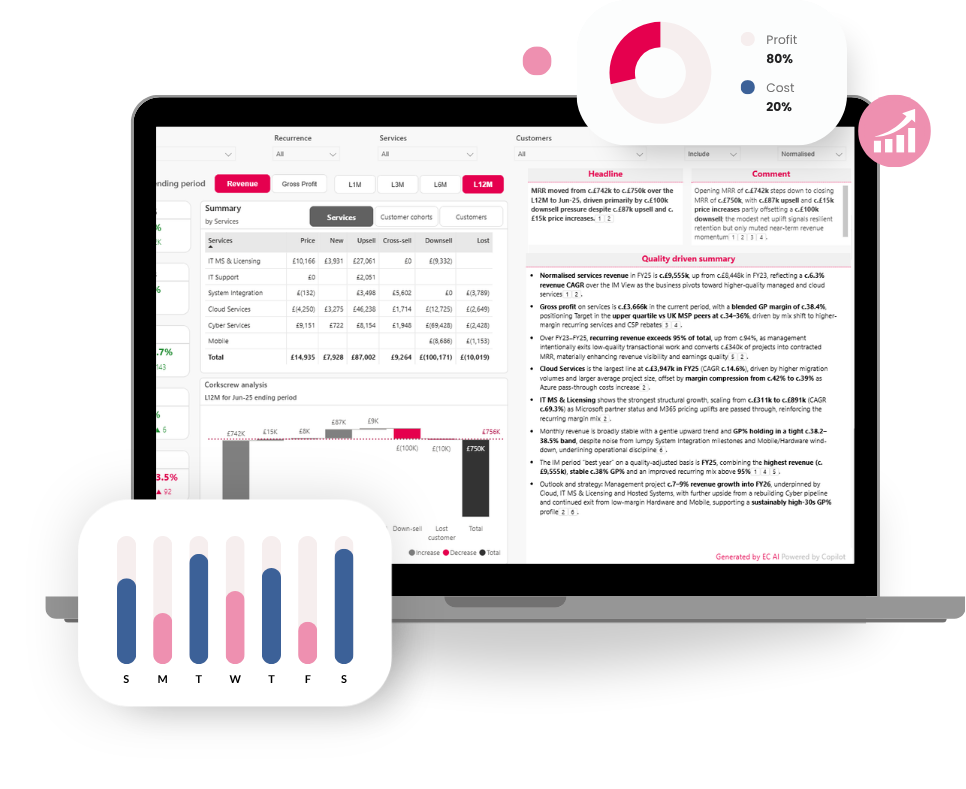
EC Analytics (Virtual CFO / CFO Assist) builds the customer data infrastructure that demonstrates revenue quality to buyers before they ask for it. This means a live contracted revenue waterfall showing when every significant contract is at risk, customer-level revenue analysis tracking cohort retention over time, pricing history by customer that evidence pricing power, and gross margin by service line and by customer that reveals where the business actually makes its money. The businesses that come to market with this analysis prepared and maintained consistently over 18 to 24 months move through FDD faster and with buyers who are more confident in the numbers, which translates directly into multiple and deal certainty.
Corporate Finance. When you are ready to go to market, we structure the revenue quality story, so buyers understand and pay for it rather than discounting it. We know where the credibility thresholds are for ARR claims, professional services classification, and hardware revenue normalisation, and we position businesses on the right side of them.
Churn and Concentration: The Risk Multipliers
A Note on Confidentiality
- Our Blog
Related Articles
What is a good net revenue retention rate for an IT MSP?
Above 100% is the threshold that attracts premium valuations, meaning existing customers are spending more year on year without any new logo acquisition. Above 105% is strong. Below 95% signals structural revenue erosion and will attract scrutiny during diligence.
How much does customer concentration affect valuation when selling an IT services business?
There is no universal answer, but the general principle is: earlier than most founders think, later than they fear. Senior managers who are brought in at the right moment, briefed clearly, and made to feel part of the outcome are more likely to perform well during the process and support the transition post-completion. The timing depends on whether they are needed for diligence preparation, whether there is a risk of leaks, and your personal relationship with each individual. Your advisers should help you think through the sequencing.
Do buyers value professional services revenue in MSP acquisitions?
Yes, but at a discount to pure recurring revenue, typically 60 to 70% of equivalent value, reflecting the execution dependency of project work. Well-documented evidence of consistent annual professional services spend from the managed services customer base reduces this discount meaningfully.
Is hardware revenue valued in IT services M&A?
Yes, when positioned correctly. Buyers look beyond headline hardware revenue to assess whether it reflects normalised annual activity or has been inflated by major refresh cycles in the period under review. Evidence of embedded involvement in customer technology planning, high win rates on refresh projects, and integration with managed services all add value.
What is the difference between logo churn and revenue churn?
Logo churn measures the percentage of customers lost. Revenue churn measures the percentage of revenue those customers represented. A business losing small customers while retaining large ones can have high logo churn but low revenue churn. Buyers price revenue churn, not logo churn.
How early should I start preparing revenue quality for an exit?
18 to 24 months is the minimum meaningful window. FDD typically covers three to five years of trading history, so improvements made close to sale will appear in the data. A longer run of cleaner metrics, consistent pricing history, and documented churn analysis is always more compelling to buyers.
- FAQ
Frequently Asked Questions
- Request a Confidential Consultation
Discover Your Business Value
Start with a strategic assessment to understand your maximum potential valuation in the current market.

Company
About Us
Blogs
Our Location
Careers
Our Services
About Us
Sell Side
Buy Side
Data Work
Resources
Faq
Client Dashboard
Support
Our Location
Contact Us
- (020) 3696 2810
- Info@evolutioncapital.com
- 68 King William Street, London, EC4N 7HR
- The Granary, Oak Lane, Chichester, PO20 7FD